
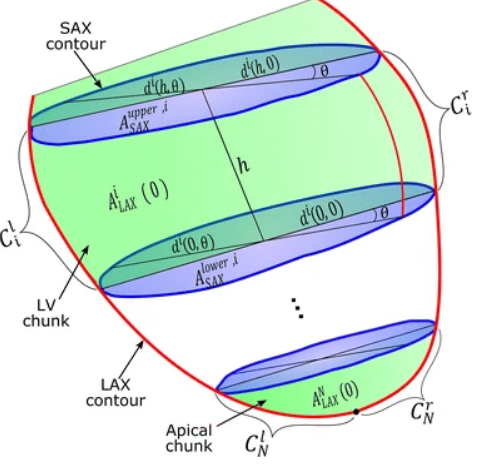
Improved estimation of the cardiac global function using combined long and short axis MRI images of the heart
Background: Estimating the left ventricular (LV) volumes at the different cardiac phases is necessary for evaluating the cardiac global function. In cardiac magnetic resonance imaging, accurate estimation of the LV volumes requires the processing a relatively large number of parallel short-axis cross-sectional images of the LV (typically from 9 to 12). Nevertheless, it is inevitable sometimes to estimate the volume from a small number of cross-sectional images, which can lead to a significant reduction of the volume estimation accuracy. This usually encountered when a number of cross-sectional
Artificial Intelligence
Healthcare
Circuit Theory and Applications
Innovation, Entrepreneurship and Competitiveness
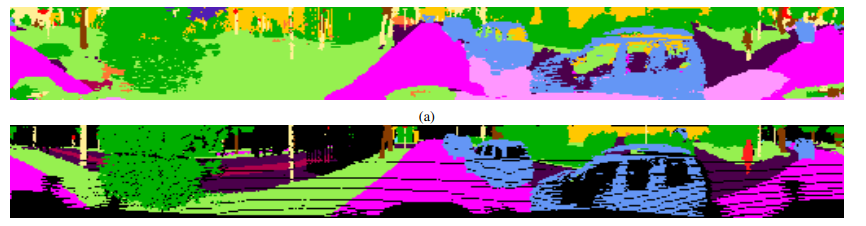
Improved Semantic Segmentation of Low-Resolution 3D Point Clouds Using Supervised Domain Adaptation
One of the key challenges in applying deep learning to solve real-life problems is the lack of large annotated datasets. Furthermore, for a deep learning model to perform well on the test set, all samples in the training and test sets should be independent and identically distributed (i.i.d.), which means that test samples should be similar to the samples that were used to train the model. In many cases, however, the underlying training and test set distributions are different. In such cases, it is common to adapt the test samples by transforming them to their equivalent counterparts in the
Artificial Intelligence
Healthcare
Energy and Water
Software and Communications
Agriculture and Crops
Innovation, Entrepreneurship and Competitiveness
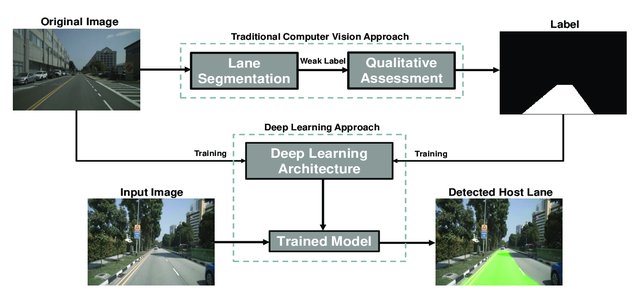
A Deep Learning-Based Benchmarking Framework for Lane Segmentation in the Complex and Dynamic Road Scenes
Automatic lane detection is a classical task in autonomous vehicles that traditional computer vision techniques can perform. However, such techniques lack reliability for achieving high accuracy while maintaining adequate time complexity in the context of real-time detection in complex and dynamic road scenes. Deep neural networks have proved their ability to achieve competing accuracy and time complexity while training them on manually labeled data. Yet, the unavailability of segmentation masks for host lanes in harsh road environments hinders fully supervised methods’ operability on such a
Artificial Intelligence